

Artificial intelligence and rapidly developing technologies are changing the world before our eyes, at lightning speed… Relationships, professions, the way work is done, tastes and demands are all shifting, and along with all of this, people themselves are changing. No one knows what kind of world we will wake up in tomorrow, but we know for certain that nothing will be the way it was before.
Against the backdrop of these turning-point events, questions arise: What will the world and Georgian media look like tomorrow? How will technological change affect them? What will disappear, what will be introduced, and what will change?
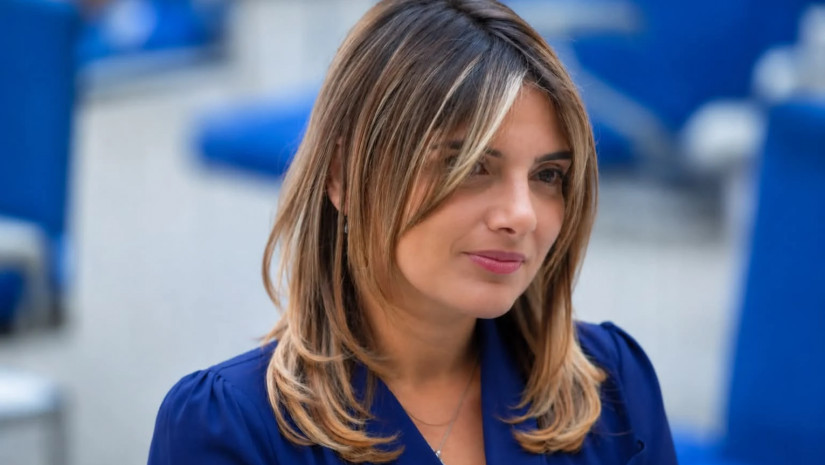
We recorded an interview on this topic with Ketevan Khositashvili, editor-in-chief of the media holding “Kvira,” who shared her views with us.
- It is very hard to talk about the future from where we stand, but let’s try anyway. Do you think artificial intelligence will replace the media within the next five years?
- I think this is a very topical issue today, and it is essential that we discuss such matters openly.
In its time, the internet changed the speed at which information spreads, and social networks changed the way it is consumed. Artificial intelligence, for its part, is changing the very rules by which information is produced, verified, and perceived.
Of course, it is not easy to talk even about the near future from this vantage point, when we can see that we are standing at the very beginning of changes whose scale we still cannot fully grasp. Still, before I share my views in more detail, I want to state my position right away: I believe artificial intelligence will not be able to replace journalism entirely, but it will change a large part of journalism’s current workflows. These are two different things. Let’s take it step by step: first we will look at the issue on a global scale, and then move on to Georgia.
Looking at it globally, my forecast is that the production of information will become cheaper, and the pace of its preparation and distribution will increase. Today, for example, a single news item might involve a journalist who gathers the information, an editor who processes the text, a translator, a photographer or videographer, a designer, a social media manager…
In the future, one person will probably be able to perform most of these tasks with the help of several AI tools. A journalist, for example, will gather information, verify sources, use AI to prepare a first draft of the text in several languages, and create video subtitles, headline options, and material in various formats for social networks. This means that a single journalist’s productivity could increase several times over.
But there is another side to this: if producing information becomes cheap and easy, even more low-quality, repetitive, artificially generated content will appear online. As a result, an abundance of information will no longer be an advantage. The advantage will be the reliability of information.
This challenge concerns the world’s media as a whole. Media will not disappear in the literal sense of the word, but who creates information, who distributes it, who holds the audience, and, most importantly, whom readers and viewers trust will change significantly.
- So how will traditional media change?
- If we try to forecast the near future, I think television will not die, but it will change significantly. Live broadcasting, for example, will retain its importance during political crises, elections, wars, emergencies, and major public events.
Television’s digital products (programs, interviews, and reports) will spread more and more on YouTube, social networks, and various apps. Consumption of personalized information will also grow. Viewers will have more opportunity to choose for themselves who they receive information from, when, in what form, and for how long.
TV channels that depend solely on traditional broadcasting will probably lose part of their audience.
But there is something television still does very well, and in this respect it is, for now, irreplaceable: live broadcasting creates a shared information space. When something important happens in the country, people want to see with their own eyes what is happening at that very moment. I think this need will persist for a long time.
- What will happen to print publications?
- Print publications will probably shrink even further. However, I believe newspapers and magazines will not disappear entirely.
For example, the future existence of some newspapers may rest not so much on the need to inform the public daily as on their image, reputational, or historical value. A publication may continue to exist because it has a long history and has become a valuable part of a country’s social and cultural life.
At the same time, print media may become a more specialized product. I mean high-quality analytical magazines and cultural, literary, and other thematic publications that will have their own loyal audiences.
- What can you say about online media? You yourself head a news agency, and I’m sure you have thought about its future…
- Of course I have. My forecast is that the traditional online news agency model, built on quickly finding information, translating it, writing a headline, and publishing it on a website, will come under the greatest pressure from technological change.
The reason is already evident: AI can monitor foreign media, translate information, prepare a short news item from several sources, extract text from video and transcribe it, summarize information on various topics, adapt material into several languages, and so on. Naturally, this makes the work process much easier for us media managers, but at the same time it creates new challenges.
We should not forget that many people already have a personal AI assistant that they can easily ask what happened today in, say, Georgia, Europe, or Asia, and instantly receive short, summarized answers.
Consequently, readers may soon no longer need to open ten news sites at all. This creates a new problem for online agencies: if readers are already getting information from artificial intelligence, why should they visit a particular agency’s website? I think this is one of the most important questions for the media of the future.
However, another, equally important issue arises here: who decides which media outlets’ information is included in an AI assistant’s response — and which is left out? We already know that the selection of information is influenced by the design of technological systems, the sources available to them, and the rules set by companies. But we do not yet know what the information distribution system will look like in the future, how transparent its operation will become, and what influence big technology companies will have on it.
This is a contentious issue that deserves careful thought, and in the future it could become one of the major challenges to media independence.
I see another interesting paradox in this process: the more information artificial intelligence produces, the more valuable information gathered, verified, and thought through by a human being may become.
That is why I believe the main battle in the future of journalism will be not between humans and artificial intelligence, but between trustworthy information and information noise.
My main advice to Georgian media professionals would be this: let’s not compete with artificial intelligence on speed. Our advantage should be depth, reliability, and professionalism, and we should use technology to ease heavy and routine work.
So my prediction is that the journalism profession will not disappear entirely. On the contrary, new business models for media may emerge, and specialized and author-led media outlets may grow stronger, although some job functions in journalism will require direct human involvement less and less.
- Even so, which jobs in the field will be at risk?
- On this subject, the 2026 Reuters Institute study is interesting; it surveyed 280 media leaders from 51 countries. According to the study, publishers expect Google search traffic to fall by 43% over the next three years. This is already a direct challenge to the business model of online publications.
As for employment specifically, in my personal forecast, the development of AI will inevitably lead to a reduction in the number of jobs in the media sector. Of course, not everyone may share this assessment, but as a media manager I can already see how the list of tasks that can be done with far fewer human resources, with the help of technology, keeps growing.
Journalists whose work mostly consists of rewriting news from other sources will probably be at high risk of replacement. A large share of routine translation and technical proofreading will be automated, the technical side of video editing will become much simpler, and the functions of social media content managers will change, among others.
However, this does not mean that the professional value of a journalist will diminish. On the contrary, the skills that define real journalistic work will become especially important.
Journalism is not just writing text. A good journalist can win over a source who does not want to talk to anyone else; spot a contradiction in an official statement; notice that a respondent is hiding something; earn a person’s trust and build a personal rapport; go to the scene and see reality with their own eyes; ask a question no one else has thought of; and, most importantly, take responsibility for the information they publish.
AI can also assist an investigative journalist, for example by processing vast numbers of documents, discovering connections within data, and highlighting important details. But it lacks a journalist’s professional and ethical responsibility, and it cannot independently replace the human relationships and real-world actions on which a significant part of journalistic work rests.
That is why I believe investigative journalists, strong analysts, reporters, interviewers, and those professionals who have their own sources and the ability to obtain information independently will retain particular value.
I would also like to touch on the future role of media managers. In my view, the advantage will go to managers who keep pace with technological development, always know what is new in the field, and use AI’s capabilities properly, as supporting tools.
But simply adopting new technologies will not be enough. The key task will be to train journalists and foster their professional growth: journalists with genuine journalistic skills, who can obtain information independently from their own sources, produce high-quality analytical and investigative material, and assess information critically, while also being versatile professionals who use modern technology with ease.
I think the future belongs to precisely such all-round journalists. And one of media managers’ main tasks will be to discover and train these people and to create the right environment for their development.
That is why, in my opinion, a successful newsroom in the future will not simply be the one equipped with the most modern technology. The successful one will be the one that properly combines technological capabilities with the professionalism of a strong journalistic team.
As for Georgia, the changes here could be more painful, owing to several particular circumstances.
First, Georgian media is a relatively small market. Second, advertising revenue is limited. Third, many media outlets are financially and politically vulnerable. Fourth, professional journalistic resources and technological capabilities vary from one newsroom to another.
Therefore, in Georgia, AI’s influence will probably show up in two directions at once: on the one hand, it will make work easier for small media outlets; on the other, it will further intensify competition and employment challenges.
There is another peculiarity here: in Georgia, an online agency’s existence and its real influence on the audience are not the same thing. A media outlet may have a website and publish dozens of news items every day, yet its content may reach readers mainly through Facebook. This dependence could become a serious risk in the future.
- What risks specifically are you talking about?
- For example, if Facebook’s or another platform’s algorithm changes, or users increasingly start getting information through AI assistants, an agency could lose a significant share of visits to its website. That could lead to lower advertising revenue and a weaker direct connection with the audience.
This is a serious challenge for us in online media.
Against this background, my forecast is that the outlets that retain a competitive advantage will be those whose main capital is exclusive information, their own sources, investigative journalism, the personal authority of strong journalists, analytical material, reliability, and specialization in particular topics.
I don’t think the strongest media of the future will necessarily be the biggest. A relatively small publication with a few standout journalists, its own sources, and a high level of reader trust may become the most influential.
That is a real opportunity for Georgian media, too.
As for Georgian television, I think it will retain its political and social influence for a long time yet. However, the traditional TV audience will gradually age, because the attention of the younger generation is already directed toward the digital space. For a large share of young people, YouTube, TikTok, and other digital platforms are now an important source of information.
So Georgian television will have to change not only its forms of broadcasting but also its model of engaging with the audience.
- Let’s talk about another serious threat: disinformation and AI-generated material. How big a challenge is this for Georgia?
- Of course, this is one of the most serious challenges for the world’s media and for Georgia alike.
We stepped into the world of so-called fakes long ago, step by step, into that vast digital ocean where it is increasingly hard to tell truth from lies. Everything is so chaotic, and fake photos, videos, and information so closely resemble the real thing, that sometimes even professionals struggle to recognize them.
This issue worries me greatly, as it does many of my colleagues.
Over time, controlling the accuracy, quality, and ethical compliance of AI-generated material will become even more difficult. I think this situation will foster the emergence of new specialties, both worldwide and in Georgia.
Demand will grow for professionals who can identify, verify, and assess fake photos, videos, so-called deepfakes, and manipulative information.
I don’t rule out that the role of AI content editor will also become more widely established in newsrooms: specialists who will check the accuracy, quality, and ethical compliance of material prepared with the help of AI. Such roles are already developing in the world’s media and will probably become even more important.
However, this is not only about creating new specialties. I think that in the future every journalist will need much stronger critical thinking, the ability to verify information, and the awareness that material prepared by technology is not automatically reliable.
Ultimately, however technologies develop, the media’s main value will still be public trust. And that trust cannot be earned through speed, modern software, and an abundance of information alone.
So if you ask me what the main task of journalism will be in the age of artificial intelligence, my answer is this: to preserve the professional principles for which society needs journalism in the first place: the search for truth, independence, critical thinking, and responsibility.
Technologies will change, and the ways information is distributed will change, but it is precisely these values that will determine what kind of media we have in the future.